
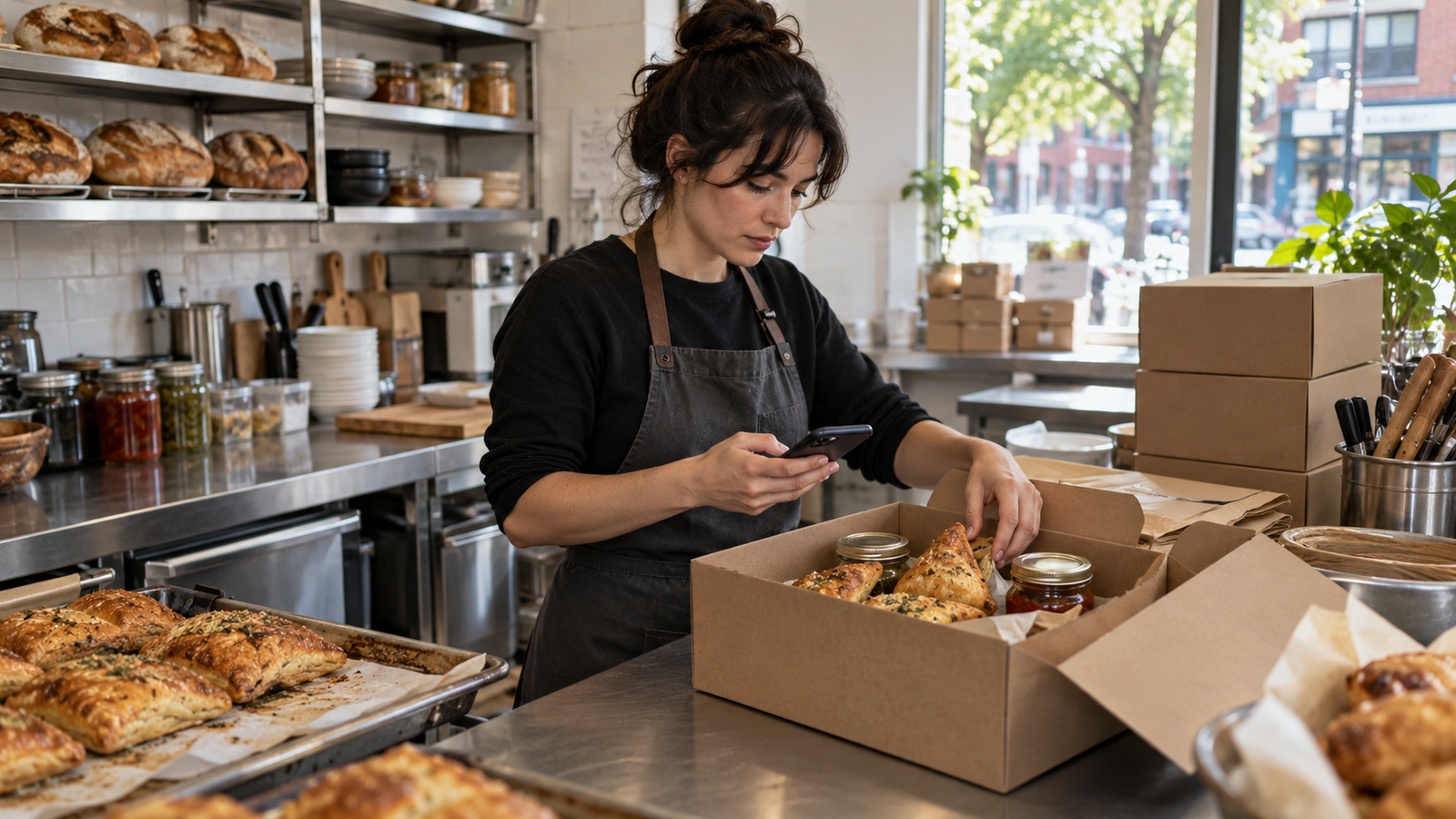
Small Food Business Delivery in Toronto: Get Direct Orders to Customers Safely
A Toronto small food business delivery guide for direct orders: plan pickup, disclose food handling needs, pack clearly and prevent failed customer handoffs.
A customer orders two jars of chutney, a box of savoury pastries and a gift note from a neighbourhood food maker. The kitchen can make the order perfectly. The delivery goes wrong when the jars travel loose, the pickup is requested before the pastries are boxed, or the buyer’s building will not let a courier leave food in the lobby.
Small food businesses in Toronto often grow from market tables, social messages and repeat local customers. Direct delivery gives the business more control over the relationship, but it also makes the shop responsible for a promise beyond the kitchen door. This is a plan for getting a modest number of orders out reliably without pretending every product has the same transport needs.
Decide which products can share a run
Start with the product, not the neighbourhood. A shelf-stable sealed jar, a fresh pastry and a chilled prepared food can require different packaging and handling. Separate items that could crush, leak or transfer odour. Keep glass from knocking against glass. Put food into secure outer packaging that keeps the order together and allows a clear piece count at pickup and delivery.
Potentially hazardous food needs an appropriate temperature plan during transport. Ontario’s Food Premises regulation sets conditions for distributing and transporting that food, generally at 4°C or below or 60°C or above, subject to the regulation’s specific exceptions. A regular local courier booking does not automatically include a refrigerated or heated vehicle. Tell dispatch what is in the order and what conditions it needs. If the available service cannot meet those conditions, choose another transport arrangement rather than assuming a shorter drive makes it safe.
This is not a reason to treat every loaf or dry biscuit as if it were a chilled meal. It is a reason to classify the items honestly. The producer should decide the food-safety requirement and confirm that the packaging, route and equipment fit it. The courier needs that information before accepting the work.
Use an order cutoff that protects the kitchen
A same-day promise needs a preparation cutoff and a delivery cutoff. If your food is made in batches, publish the last order time for that batch. Leave time for cooling or other required food handling, packing, label checks and a final count. “Courier pickup at 1” is useful only when the parcel will be sealed and ready at 1, not when cooking is scheduled to finish then.
For a small shop, a practical system can be a single dispatch sheet: order reference, buyer name, destination, unit or buzzer, recipient phone, product count, packaging count, pickup-ready time and required receiving window. A separate column for special handling avoids burying important information in a long chat thread. If a buyer changes an address after the order is packed, update the sheet and ask dispatch to reconfirm the route and price.
Do not solve every late order with an emergency courier. A planned same-day window may be suitable if the product is ready and the customer can receive it. Reserve urgent service for a real deadline, such as an approved event handoff, and confirm availability before promising it at checkout.
Make the package understandable to two people
The person who hands over the order and the person who receives it may never speak. Put the order reference, destination and piece count on the outer package. Keep customer data limited to what is needed for delivery. If separate cartons form one customer order, mark them as one of two and two of two. Add a packing slip inside if it helps the buyer check the items without putting private details in public view.
Allergen questions deserve their own process. Customers may ask whether a product contains nuts, sesame, milk or another ingredient. The food business, not the courier, must answer using its recipe and production controls. If the product is packaged for sale, applicable Canadian labelling rules may require specific declarations. Do not ask a driver to interpret an ingredient list or promise a product is “allergen-free” from memory. Give buyers a reliable way to ask the kitchen before purchase.
When a customer reports a missing item, the package count and a photo at release help identify whether the issue happened in packing, transport or receiving. That record should support a calm customer response, not become an excuse to avoid one.
Plan the last five metres
Many delivery failures happen after the vehicle reaches the address. A condo may require a buzzer code and prohibit food at concierge. A storefront may have a rear receiving door. An office may close the front desk early. Ask the buyer where the food may be handed over and who can accept it. For a gift order, confirm whether the recipient expects a call. For an event, provide the venue’s loading and sign-off instructions rather than only the public entrance.
Give customers a delivery window that dispatch has confirmed, then tell them how to prepare: keep the phone reachable, check the buzzer and be ready to receive food that should not sit outside. If the recipient cannot be reached, the courier should follow an agreed exception path through dispatch. A food parcel should not be left on a warm step or in an unsecured hallway simply because the address is correct.
When should a small producer use a repeat route?
Once orders repeat on the same days, a planned route can reduce the daily scramble. Look at a real month of orders before drawing the map. Some customers may order weekly; others only for weekends. Cluster stops by confirmed receiving windows and product conditions, not only distance. One chilled order cannot be casually added to a route built for shelf-stable goods.
Keep a cutoff for weekly changes, and ask the team to check the stop sheet before packing. The meal-prep route guide explains the operational side of repeat stops. Our specialty-food service page describes what to tell dispatch before a route is confirmed. Neither page replaces the producer’s own food-safety plan.
A release checklist for direct orders
- Check the recipe, order reference and physical item count.
- Identify which products need temperature control or special handling.
- Use containers and outer cartons that prevent leaks, shifting and breakage.
- Confirm any required product information or allergen response with the kitchen.
- Match the destination, unit, phone and receiving window to the current order.
- Ask dispatch to confirm suitability, price and timing before promising delivery.
Questions small food businesses ask
Can a standard courier take chilled or hot prepared food?
Do not assume it can. Identify the required transport conditions and ask dispatch whether the specific service and equipment can maintain them. If not, use a suitable alternative.
What if a customer changes the address after the package is ready?
Update the order record and contact dispatch before collection or rerouting. A new address can change the delivery window, suitability and price.
Does the driver answer questions about ingredients or allergens?
No. Give customers a direct way to obtain accurate product information from the food business. The courier’s role is the confirmed transport and handoff.
Is a group of nearby customers always cheaper to deliver together?
Not necessarily. Product conditions, receiving hours, parking and wait time can change the route. Share the complete stop list so dispatch can assess a realistic plan.
A direct-order delivery system does not need to be complicated. It needs honest product handling, a ready parcel and a person who can receive it. For a different kind of repeat food route, see the tiffin and mess subscription guide. For a non-food example of careful fragile handoffs, read the flower shop peak-day guide. When the package and route are clear, send a booking request and wait for dispatch confirmation.