
Flower Shop Delivery in Toronto: A Plan for the Days Every Order Matters
Plan flower shop delivery in Toronto for busy days with realistic order cutoffs, upright packing, recipient instructions and a clear exception plan.
At 10:15 on a busy Friday, a flower shop has seven bouquets ready, three waiting for ribbon, and one customer asking whether a surprise can reach a downtown office before lunch. The temptation is to say yes to everything and sort out the route later. That is often when a good arrangement becomes a difficult delivery.
This guide is for independent florists in Toronto and nearby GTA communities who handle the flowers well but need a stronger plan for peak-order days. Valentine’s Day and Mother’s Day are obvious examples, but the same pressure appears around graduations, weddings and corporate events. The aim is not to move every bouquet at the same speed. It is to make a promise the shop, courier and recipient can actually keep.
Set a cutoff based on finished bouquets, not checkout time
An online order is not ready for a driver the moment it is paid for. A florist still needs to check stem availability, make the arrangement, write the card, pack it and confirm the address. Work backwards from the desired delivery window. If the shop cannot finish and release an order before a realistic pickup, offer a later window rather than displaying “same day” as an unconditional promise.
Write down the last time the shop can accept a new order for each window. Leave room for a substitution call and for the person arranging flowers to finish the piece without rushing. If a customer selects a specific bloom that is unavailable, the replacement should be approved before the card and label are attached. A courier should never be asked to resolve a substitution conversation at the door.
When you quote a customer, separate three moments: order accepted, bouquet ready for collection, and delivery window confirmed by dispatch. Those times can be close together on a quiet day and very different on a holiday. Keeping them distinct makes customer service easier when someone asks, “Has it gone out yet?”
Sort the orders by receiving deadline
Make one short route sheet for every planned wave. A downtown office that closes its receiving desk at 4 p.m. is different from a house where someone is home all evening. A hospital, hotel or event venue may have its own receiving point and rules. List the hard cutoff first, then the exact street address, unit, phone, entrance and permitted handoff. Only after that should you group stops that happen to be near each other on a map.
One well-planned pickup might cover several offices in the same area. Another bouquet may need a direct run because a ceremony begins at a fixed time. If you are comparing same-day courier options, give dispatch the real deadline and the number of pieces. A one-hour option may be available for an eligible route, but the label alone does not make an unfinished bouquet or an unreachable recipient ready.
On a particularly busy day, mark each order as ready, awaiting approval, or not yet made. Do not put an unfinished order into a courier batch because it shares a postal code with the finished ones. It is cheaper to make a second honest plan than to keep a driver waiting while every later recipient loses time.
Pack for turns, elevators and winter air
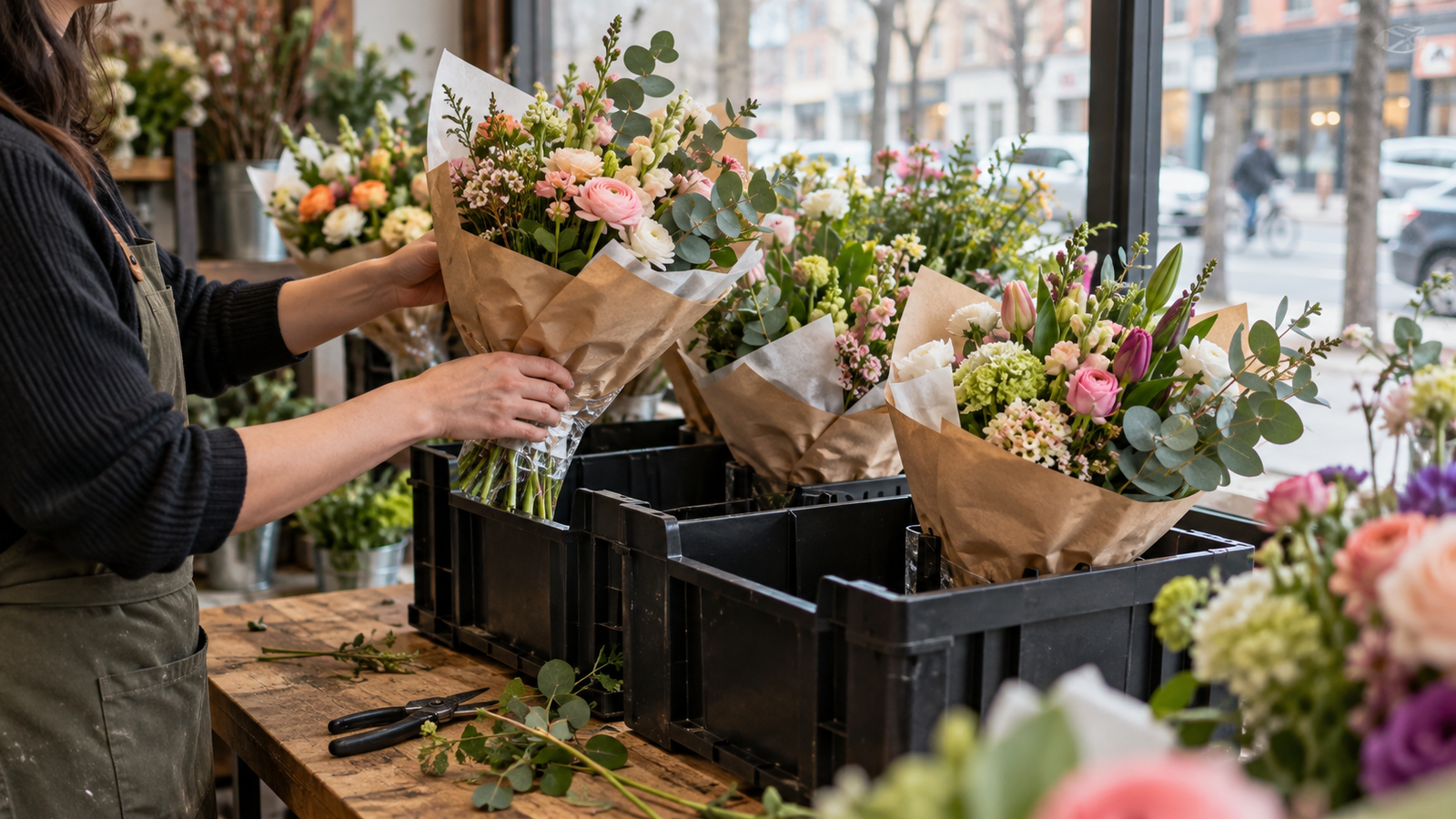
Bouquets should stand upright and be supported so one sharp turn does not press petals against a neighbouring parcel. Keep a vase base stable and manage water before it reaches a vehicle. Separate tall arrangements from low gift boxes, and count add-ons such as a card or small gift as physical pieces. A simple shop photo at release gives your team a reference if someone later asks about the condition of the bouquet.
Toronto weather changes the handoff decision. A warm arrangement left outside on a freezing day can be damaged before the recipient knows it arrived. On a hot day, a sunny front step is not a good holding area either. Agree in advance whether the recipient must answer personally, whether a staffed desk can accept the flowers, or whether dispatch should call the shop if no one is available. Do not assume every condo concierge accepts flowers.
Care after delivery also matters. A short care card can remind the recipient to use a clean vase, check water and keep cut flowers away from heat. Penn State Extension’s cut-flower care guidance supports those basic steps. The card is useful, but it cannot make up for flowers left in the wrong place for hours.
Make a no-answer rule before the driver leaves
The customer who ordered flowers may not be the person receiving them. Surprise gifts create an awkward gap: the buyer knows the plan, while the recipient may ignore an unknown call. Ask the buyer for a working recipient number where appropriate and for an acceptable fallback. If the delivery is a surprise, agree on a discreet contact method or a named reception desk.
Keep a short exception note on the order: call recipient once, try the buzzer, contact dispatch, then call the shop. The exact sequence can vary, but it should be decided before the driver reaches the building. The courier should not choose a doorstep, neighbour or lobby table on the shop’s behalf. If a second trip becomes necessary, tell the buyer promptly and explain what can be confirmed next.
A ten-minute peak-day check
- Confirm the bouquet matches the approved order or approved substitution.
- Check the card text, destination label, unit number and recipient phone.
- Count every piece and secure the arrangement upright.
- Sort office, venue and residential stops by real receiving window.
- Record what happens if a recipient does not answer.
- Release only finished orders to the confirmed courier pickup.
These checks take less time than chasing a bouquet after a failed handoff. If your shop runs similar local deliveries every week, a scheduled route may help with regular corporate flowers or event prep. Keep special-occasion surges separate so a recurring route does not silently inherit an impossible number of stops.
Questions florists and customers often ask
Can a Toronto flower shop guarantee an exact delivery minute?
Only promise a time that the shop and dispatch have actually confirmed. Preparation, traffic and building access can all change an arrival. A realistic window plus a named receiving contact is usually more useful than an unsupported exact-minute promise.
Should flowers be left with a condo concierge?
Only if the building accepts them and the buyer or recipient has approved that handoff. Give the courier the concierge instructions, unit and recipient contact before collection. A completed lobby drop is not always the handoff the customer expected.
What if a recipient is away in freezing weather?
Do not assume an outdoor doorstep is safe for the arrangement. Follow the agreed exception plan, contact the shop through dispatch and confirm whether a staffed indoor receiver or another delivery arrangement is possible.
Can several bouquets share one courier run?
Sometimes. Give dispatch every address, size, receiving window and piece count. Grouping only by neighbourhood can fail when one office closes early or a large arrangement needs more vehicle space.
A good flower delivery is a finished arrangement, a truthful window and a handoff somebody agreed to. For more on fragile recipient handoffs, read our florist courier guide. Other local businesses face different last-mile problems: the small food business guide covers sealed orders and food conditions, while the tiffin and mess guide looks at repeat meal subscriptions. To discuss a flower-shop route, send the addresses and timing for dispatch review.