
A customer is standing in a Toronto shop ready to buy the last jacket in a particular size. The sales associate checks inventory and sees one at the company's Mississauga location. The item exists, but the promise to the customer depends on more than a vehicle. Someone must pull the right SKU, pack it, authorize the movement, and make sure the Toronto team can receive it while the customer still wants it.
Store-to-store courier work across the GTA is a small supply-chain decision, not just a trip between two postal codes. This guide is for retailers with multiple branches, a back-room warehouse or a seasonal pop-up. It focuses on a stock transfer that can be counted and trusted. For the customer-facing trip after the item reaches the store, read our condo delivery handoff checklist. For goods coming back from a buyer, see the separate local returns guide.
First ask whether the transfer is worth making today
Not every empty shelf needs a same-day vehicle. Decide when the receiving store actually needs the item, whether the sending location can spare it, and whether the customer has committed to collection or delivery. A $20 item needed sometime next week belongs on a planned replenishment run. A high-value item reserved for a customer today may justify a separate courier quote. The right answer comes from margin, customer expectation and a real receiving window, not from a blanket “rush everything” rule.
Check inventory physically. A system count of one can be a misplaced display sample, an item in a fitting room or a damaged box awaiting a write-off. The sending store should confirm the SKU, colour, size and condition before dispatch accepts the job. If the customer wants a matching pair or a complete set, check all pieces together. A courier cannot fix a picking error after the transfer reaches the destination.
Give one person authority to release the transfer. That avoids the awkward case where a branch manager promises an item to a walk-in customer while head office has already assigned it to another store. Use a transfer reference that both locations can find. Do not rely on a driver to interpret screenshots of inventory messages from several group chats.
Pack for counting, not just for the drive
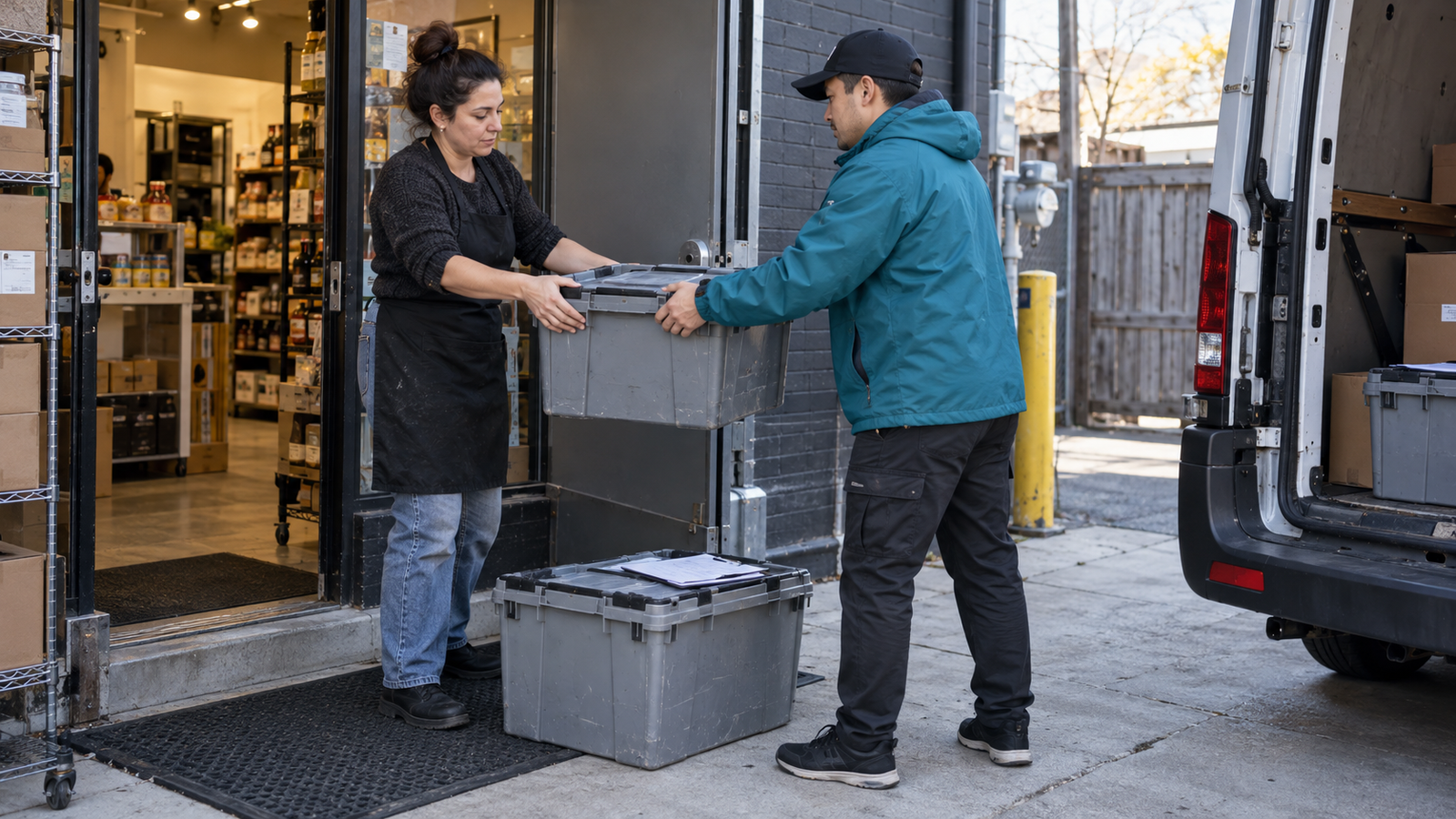
A practical manifest lists the origin, destination, transfer reference and number of sealed transport units. The retailer's inventory system can hold the SKU-level detail. At pickup, the sending team should count the boxes or totes with the courier. At drop-off, the receiving team should confirm the same count and then check the contents under its own process. This separates transport accountability from inventory accuracy.
Label each tote on more than one side if it may be stacked. Use a destination code that staff at both ends recognize. Do not write a customer's phone number on a public-facing tote if a transfer reference is enough. If several stores share one run, colour-code or group the units so the wrong branch does not inherit another branch's stock. Reusable totes need lids that stay closed and do not invite loose items to fall out on a turn.
Tell dispatch about the actual dimensions and weight. Six garment bags, one small carton and one heavy display fixture are not interchangeable. Fragile, food or temperature-sensitive products may need handling beyond an ordinary parcel route. Confirm the service is suitable instead of assuming all inventory can ride together.
Plan the receiving door, not just the route
A Mississauga warehouse may have a straightforward dock; a Queen West storefront may have a rear lane that is difficult to find. A Markham mall may require a service corridor and a receiving appointment. Record the entrance, unit, receiver name and phone. Ask when staff can take the goods without leaving the sales floor unattended. “Store open until nine” does not mean a stock receiver is available until nine.
Toronto's Freight and Goods Movement strategy treats loading, delivery reliability and the street network as connected issues. For a retailer, that means route time should include the last few metres: legal stopping, unloading, security and the walk to the back room. A transfer scheduled only from map driving time is likely to disappoint at a busy downtown location.
If the receiver is away, have a fallback that the business has approved. Can the assistant manager sign? Is there a locked stockroom with an authorized custodian? If neither exists, the parcel may need a new attempt or a return to origin. Do not treat a photograph of stock outside a shop as proof that the business accepted it.
Keep a routine route separate from an exception
Multi-location retailers usually have predictable movements: weekly replenishment from a warehouse, display materials for a pop-up, or regular supplies for branch counters. Those can be grouped into a scheduled route with a clear manifest cutoff. Repeating the same pickup and stops can reduce planning work, but the daily piece count still needs confirmation.
The urgent jacket is an exception. Adding it to a van already halfway around Brampton may delay other stores or miss the customer's promised time. Ask dispatch whether it fits the planned route and receiving window. If not, quote a separate same-day move or give the customer a later honest date. Our overflow guide explains this decision in more detail.
Review exceptions monthly. If the same branch borrows stock every Thursday, the underlying allocation may be wrong. If a product repeatedly needs rush transfer, increase its local minimum stock or change the scheduled replenishment day. A courier can bridge a gap, but it should not hide a forecasting problem forever.
Close the inventory loop after delivery
Delivery confirmation should record when the transport units arrived and who accepted them. The receiving team should then scan or count the SKUs and flag a mismatch while the transfer is fresh. A signed tote count does not prove every item inside was correct. It does, however, help identify whether a missing unit disappeared before or after the handoff.
When the customer is waiting, tell them the difference between “in transit,” “arrived at store” and “ready for pickup.” Staff may need time to unpack, inspect and reserve the item. Promising collection as soon as the driver arrives can create another disappointed trip. A short confirmation from the receiving shop closes that gap.
For a one-off transfer between GTA locations, request a courier quote with the origin, receiving door, piece count, ready time and latest useful arrival. The purpose is not to move stock at any cost. It is to move the right stock to the right shelf with a record both stores can trust.
Frequently asked questions
When should a GTA retailer use a same-day stock transfer?
Use it when the item is physically available at another location and the receiving store can sell or use it within a confirmed window. Check the transfer cost against the value of the sale and the alternative replenishment date.
What should go on a stock-transfer manifest?
List the transfer reference, origin, destination, number of sealed transport units, receiver and any handling note. Keep detailed SKU reconciliation in the retailer's inventory system.
Can a recurring route carry urgent stock transfers?
Only if dispatch confirms the item is ready, the vehicle has room and existing delivery promises remain safe. Otherwise book a separate same-day job or a later route.
Who counts the inventory at handoff?
The sending team should count and seal the units, the courier should record transport-unit count, and the receiving team should reconcile the contents against the store's transfer record.
What if the receiving shop is closed or short-staffed?
Agree on a named alternate receiver, another window or a return instruction before dispatch. A parcel left outside a shop should not count as an accepted stock transfer unless explicitly authorized.