
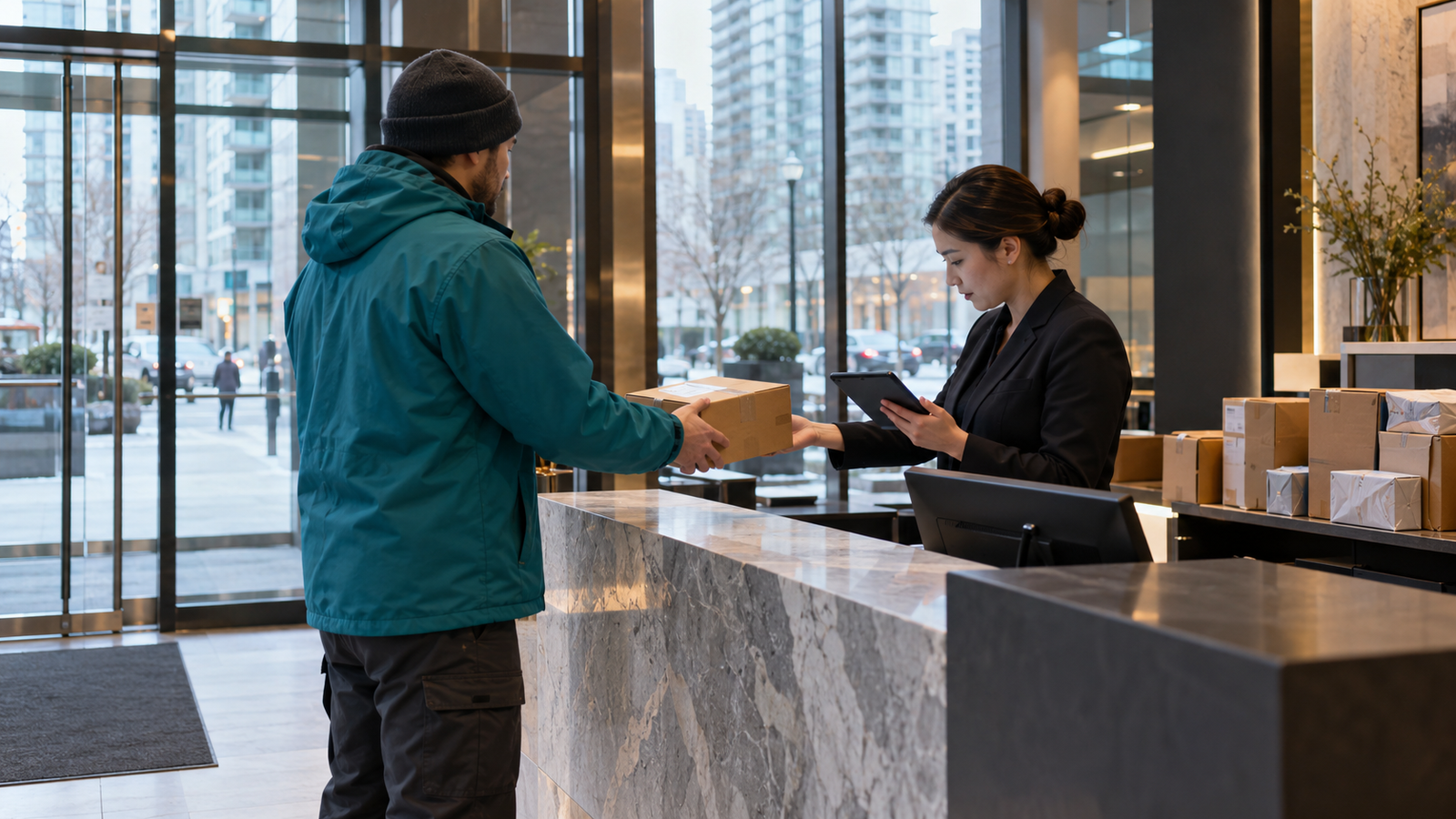
A shop on Queen Street sends a framed gift to a customer in a Liberty Village condo. The postal address is correct and the customer selected same-day delivery. The driver reaches the building, then learns the front desk does not accept oversized parcels. The resident is at work and the only loading entrance is around the block. The van arrived on time, but the delivery was never set up to succeed.
Condo delivery in Toronto and the GTA is often a building-access problem disguised as a travel-time problem. This guide is for local shops, makers and office teams sending parcels to residents or businesses in towers. It deals with the handoff, not a promise that every building allows every type of delivery. If the parcel is part of a wider local retail operation, our returns and exchanges guide covers the journey back to the store.
Ask where the delivery actually ends
“Deliver to 1200 Example Street” is not a complete instruction when the property has two towers, a shared podium and a separate parcel room. The sender should ask the resident whether the parcel goes to concierge, a package locker, a loading-dock desk or directly to the unit. That answer determines who needs to be present and what counts as completed delivery. A front-desk signature is not the same thing as a handoff to the resident.
Get the tower, unit and recipient name into the booking. If the lobby entrance differs from the street address pin, describe it in plain language. “East entrance beside the pharmacy, not the parking ramp” is more useful than repeating the building name. Include a phone number the driver can use during the delivery window. A text-only number that the resident checks hours later is not a practical backup for a locked lobby.
Ask whether concierge will accept the specific item. A small sealed box might be routine while a tall plant, a piece of furniture or a large cake is not. Some buildings have time limits for their parcel rooms or require residents to collect oversized deliveries directly. The Condominium Authority of Ontario explains that condo rules govern day-to-day activity; the operational takeaway is to confirm the building's current delivery procedure instead of assuming all towers work alike.
Separate customer convenience from courier permission
A customer may write “leave at my door” in an online order. That does not give a courier access through a locked security door or permission to use a residential elevator. Likewise, a concierge who accepts a parcel for some residents may not accept one addressed to a commercial suite or short-term guest. The sender needs a delivery method that both the customer and the building will allow.
Choose the handoff before dispatch. The options might be named recipient, authorized concierge, an approved parcel locker or a different address. Put one option first and one fallback in the booking. Do not leave an expensive or weather-sensitive item on a lobby floor because nobody answered. A delivery photo can show where a parcel was placed, but it does not turn an unauthorized location into an acceptable handoff.
For a gift, decide whether revealing the sender or contents at reception matters. Use a neutral outer label with enough information to route the item. Do not put private order details in a driver note that may be seen by building staff. If a delivery needs identity checking or a particular signature, state that requirement in advance and confirm whether the selected courier service can support it.
Build the arrival window around the building
Same-day does not mean “any time before midnight.” A residential desk may be staffed around the clock, but parcel acceptance can have different rules. A service elevator may require a booking. A retail shop sending a dozen orders into downtown towers should not assume every stop can be handled like a detached house on a quiet street.
Ask the customer for a window when they or the approved receiver can actually accept the parcel. If the resident will be away until six, a morning doorstep promise is not helpful. If the desk stops accepting deliveries at five, an evening route needs another handoff. For a building in North York, Mississauga City Centre or downtown Toronto, confirm the exact entrance and access details for that address rather than relying on the municipality name.
Allow time for legal stopping, unloading, security sign-in, elevator travel and parcel-room processing. A driver cannot necessarily pull up at the front door. A map may show a three-minute walk from a parking area, but a boxed item and a controlled entrance make that walk part of the job. If the property requires a loading appointment, the sender or receiver should arrange it and tell dispatch before the route is quoted.
Handle the awkward cases before they happen
What if the customer provides only a buzzer code and no unit? What if the desk accepts parcels but refuses perishables? What if a building's parcel lockers are full? These are not rare edge cases to solve at the curb. They are questions worth adding to a seller's checkout or order-confirmation workflow. A simple extra field for “building delivery instructions” can save a failed attempt.
Set a no-answer rule: call the recipient once, wait for a defined period if the service allows it, then contact the sender or return the shipment. The exact rule should match the booked service and any agreed charges. If the address or handoff changes after pickup, ask dispatch to confirm the revised plan. Moving the destination from a downtown lobby to a relative in Etobicoke is a new route decision, not just a note on the original order.
Ask for a completion record that identifies the actual receiver or approved drop location. If a customer later says “the building never got it,” the useful facts are the time, entrance, person or desk and the parcel reference. A generic “delivered” status is less helpful. For more detail on choosing an appropriate delivery window, see our one-business-day handoff guide.
A booking note a GTA shop can actually use
Before sending a parcel, write down: complete address and tower; unit and recipient; usable entrance; concierge or locker permission; parcel dimensions and handling needs; recipient phone; permitted proof; and the action if nobody accepts it. You do not need a complicated form. You need one complete answer that follows the parcel from checkout to dispatch to the driver.
If several condo orders go out each day, review failed attempts by building. One tower may consistently require a rear loading entrance. Another may have a staffed desk only at certain hours. Update your address notes, but re-confirm them when a customer or building rule changes. A routine that prevents one repeat failure is more valuable than a dramatic promise of instant delivery.
For a particular condo address in Toronto or the surrounding GTA, request a delivery quote with the handoff instructions and parcel size. A courier can plan around information it receives before pickup. It cannot plan around a locked door discovered after arrival.
Frequently asked questions
Will a Toronto condo concierge accept every parcel?
No. Acceptance depends on the building and the parcel. Ask the customer to confirm whether the desk accepts deliveries, its hours and any size or signature restrictions before dispatch.
What address details does a condo courier need?
Include the full street address, tower or building name if needed, unit number, recipient name and reachable phone number. Add the usable delivery entrance and any concierge or loading instructions.
Can a driver leave a package at the unit door?
Do not assume so. The building may restrict access and the customer may not have authorized an unattended delivery. Agree on the permitted handoff and no-answer rule in advance.
Who signs when the resident is away?
Only an authorized person under the booking and building rules should accept it. The sender should decide whether concierge acceptance is sufficient or whether a named recipient must receive the parcel.
What happens if the building refuses the parcel?
The courier should record the attempt and contact the sender or approved contact for a new instruction. A second attempt or return may require a revised time and charge.