
Pizza Delivery Courier for Toronto Businesses: Large Orders Beyond the App
Plan large pizza deliveries in Toronto and the GTA with kitchen-ready times, insulated handling, venue access and a named business receiver.
Forty pizzas for a staff lunch sound like a good Thursday order. Then the restaurant learns that the office is on the twenty-third floor, the building wants a loading-dock booking, half the pies must be labelled for different teams and lunch starts at exactly noon. A single receipt and a map pin do not explain the delivery. This is where a pizzeria's business-order process needs more detail than its usual neighbourhood app order.
This article is for Toronto and GTA pizza businesses arranging office lunches, school events, production crews, sports groups and other larger orders. It is about delivery operations, not a promise that any general courier can keep food hot. The restaurant remains responsible for food safety and must confirm the transport equipment and timing for each order. For a broader direct-order setup, see our small food business delivery guide.
Separate the kitchen's finish time from the customer's serve time
For a large order, “ready at 11:30” can mean the first pizzas come out at 11:30 or that the last box is sealed at 11:30. Those are very different pickup plans. Agree on the time when the complete order will be packed, checked and ready for the courier. If the kitchen needs a ten-minute count and load period, build it into the schedule rather than asking the driver to arrive while staff are still topping the final pies.
Ask the customer when people will actually eat, not just when the organizer wants the order at the door. A corporate office may need setup time for tables and signs. A school may have a fixed lunch period and a strict receiving rule. A film crew may move its meal location that morning. Work backward from the service time to the building handoff, travel, pickup and bake schedule. Add a realistic buffer, but do not bake so early that the food sits while a loading bay becomes available.
If the order is split between several addresses, confirm whether all sites can receive within one route. A five-stop lunch loop across Etobicoke, downtown and Scarborough is not the same as five floors in one campus. Time-window promises should be made only after dispatch agrees on the stop order and vehicle plan.
Count boxes, carriers and extras before handoff
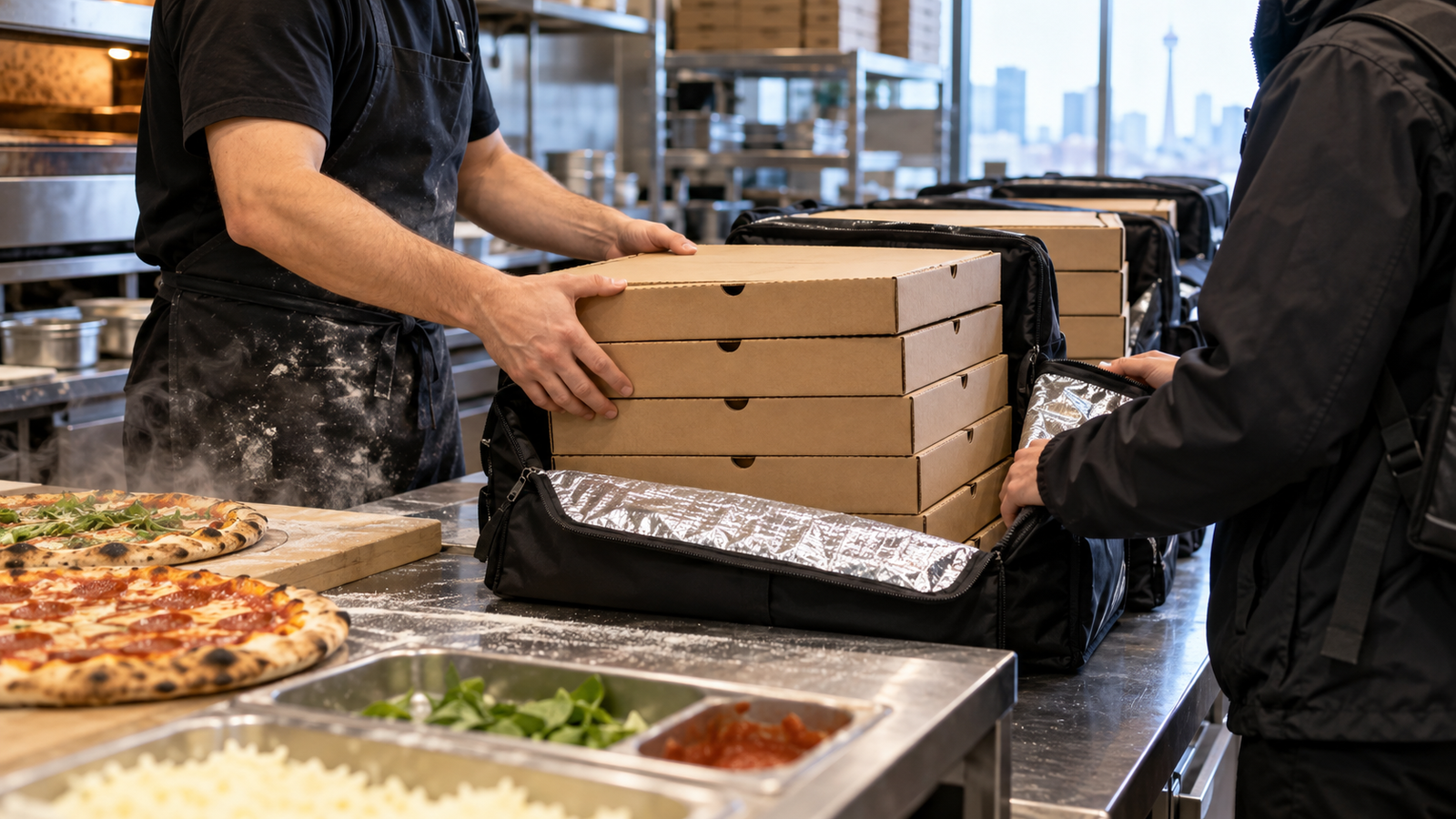
A kitchen ticket may say “40 pizzas, 10 salads, 8 drinks.” The courier needs the physical transport count. How many boxes fit in each insulated carrier? Are salads and drinks packed separately? Are there dipping sauces, plates, napkins and serving tools? Label each outer unit with the business order reference and destination, then reconcile the count at pickup. A missing side can create more customer frustration than a slightly late pie.
For several departments at one office, sort by floor or receiver before the driver arrives. Do not ask a courier to decide which team receives the vegetarian order or to open boxes to identify toppings. Put the organizer's name and a phone number on the outside of the transport grouping, not on every pizza. The business should keep its detailed ingredient and allergy records inside its own order system.
Check the vehicle and loading plan. Tall stacks can crush lower boxes or slide on a sharp turn. Large orders may require multiple carriers, a different vehicle or an extra person at the destination. Ask whether the customer will provide help to move the order from a loading dock to the eating area. Ordinary doorstep delivery does not automatically include setting up a buffet or carrying stacks through several security doors.
Make food safety a booking requirement, not a slogan
Pizza with potentially hazardous toppings, salads and other prepared foods need an appropriate food-safety plan. Ontario's Food Premises regulation specifies conditions for transporting potentially hazardous food, including internal temperatures of 4°C or lower or 60°C or higher, subject to its stated exceptions. The food business should determine how the particular order will be packed, held and checked. An insulated bag is useful equipment, but it is not proof that the food stayed at a safe temperature.
Tell dispatch what equipment the order needs and confirm the courier can support it before accepting the booking. Do not assume a standard vehicle has heated or refrigerated capacity. If the route or wait time cannot meet the food business's plan, change the service, the order schedule or the destination arrangement. Selling a temperature promise that the delivery process cannot demonstrate is a poor bargain for the restaurant and its customers.
Keep hot and cold components separated as the business's food-safety procedure requires. Seal boxes so they are protected from handling during transport. If an event organizer wants to hold food for a long time after delivery, clarify who is responsible for safe holding once the order is accepted. A delivery timestamp does not extend the safe serving window.
Get the receiving point right, especially for B2B sites
Business addresses are full of traps. A downtown tower may prohibit food couriers from the main lobby. A school may direct all outside deliveries to a specific entrance and have policies for students. A production site may have a gate number that does not appear in a consumer map app. Ask for the exact loading or meeting entrance, vehicle stopping point, receiver's mobile number and any access instructions that can be shared safely with the driver.
Use a named receiver who will be available when the courier arrives. “Leave at front desk” is not a universal fallback for a large hot-food order. A busy receptionist may not have room to hold twenty carriers. If the customer needs the driver to wait while an elevator or cart arrives, discuss that before pricing. If the event location changes, have one authorized contact confirm the revised address and window with dispatch. A casual message in a group chat may not reach the person routing the vehicle.
For GTA runs that leave Toronto, check the destination's receiving hours and the impact of traffic around the meal period. An office in Mississauga may have a simple ground-floor handoff, while a shorter downtown trip might involve a long loading delay. Distance alone will not tell you which order is easier to deliver intact.
Decide when an outside courier helps your own drivers
A pizzeria with its own delivery staff does not need to outsource every order. A business courier can be useful for a planned bulk order outside the normal radius, a second route during a peak period or a multi-site corporate account. Keep the restaurant's regular direct-to-consumer drivers on the work they know well, and quote exceptional B2B runs with the equipment, stops and handoff they require.
Before using an outside provider, compare the full cost. Add packaging, carriers, staff loading time, courier service, possible waiting and any failed attempt. Ask who answers the customer's call if the order is delayed. The restaurant owns the food and customer relationship; the courier owns the agreed transport task. Write down how both teams communicate rather than leaving the organizer to call several numbers.
If a company orders lunch every Thursday, test a repeat schedule after a few successful one-off trips. A scheduled route can reduce repeated coordination, but the menu count, serving time and receiver still need confirmation each week. If the order is a single office party, a one-time specialty food delivery discussion is more appropriate. For the pricing side of direct local orders, read our food delivery pricing guide.
A checklist for the restaurant and the office organizer
- Confirm when the complete order will be sealed and ready, not when cooking starts.
- Record the box, carrier, cold-item and extras counts at pickup.
- Agree on safe temperature handling and the equipment required.
- Get the exact entrance, floor, dock or meeting point and a named receiver.
- Separate delivery time from setup and serving time.
- Define the no-answer, waiting and changed-address procedures.
- Confirm who updates the customer and what proof of handoff is useful.
A large pizza order succeeds when the kitchen, courier and receiver are looking at the same plan. That is more useful than a generic promise to “deliver fast.” If your pizzeria has a corporate order outside its usual route, share the pickup-ready time, box count and receiving instructions for dispatch review.
Frequently asked questions
Can a Toronto courier deliver a large office pizza order?
It depends on the order, distance, equipment and food-safety plan. Give dispatch the complete box and carrier count, pickup-ready time, destination access and required receiving window. Confirm the provider can support the transport conditions before promising the customer.
Does a normal courier vehicle keep pizza at a safe temperature?
Do not assume it does. The restaurant must determine appropriate packaging, equipment and temperature checks for its food. Ask the courier what equipment is actually available and whether the route duration fits the plan.
Who should receive pizza at an office or school?
Name an organizer or authorized receiver who can meet the driver at the agreed entrance. Confirm the site's rules in advance. A main street address or front-desk label may not be enough for a large order.
Should a pizzeria outsource all of its deliveries?
Not necessarily. Many businesses can keep routine neighbourhood orders with their own drivers and use an outside courier for planned bulk, overflow or cross-GTA work. Compare full cost and customer communication before changing the process.
Can one courier serve several office pizza orders at lunch?
Possibly, but the cooking, safe holding, travel and receiving windows must fit together. Get each stop confirmed before selling exact arrival times. Separate vehicles or a different schedule may be necessary for a tight lunch window.