
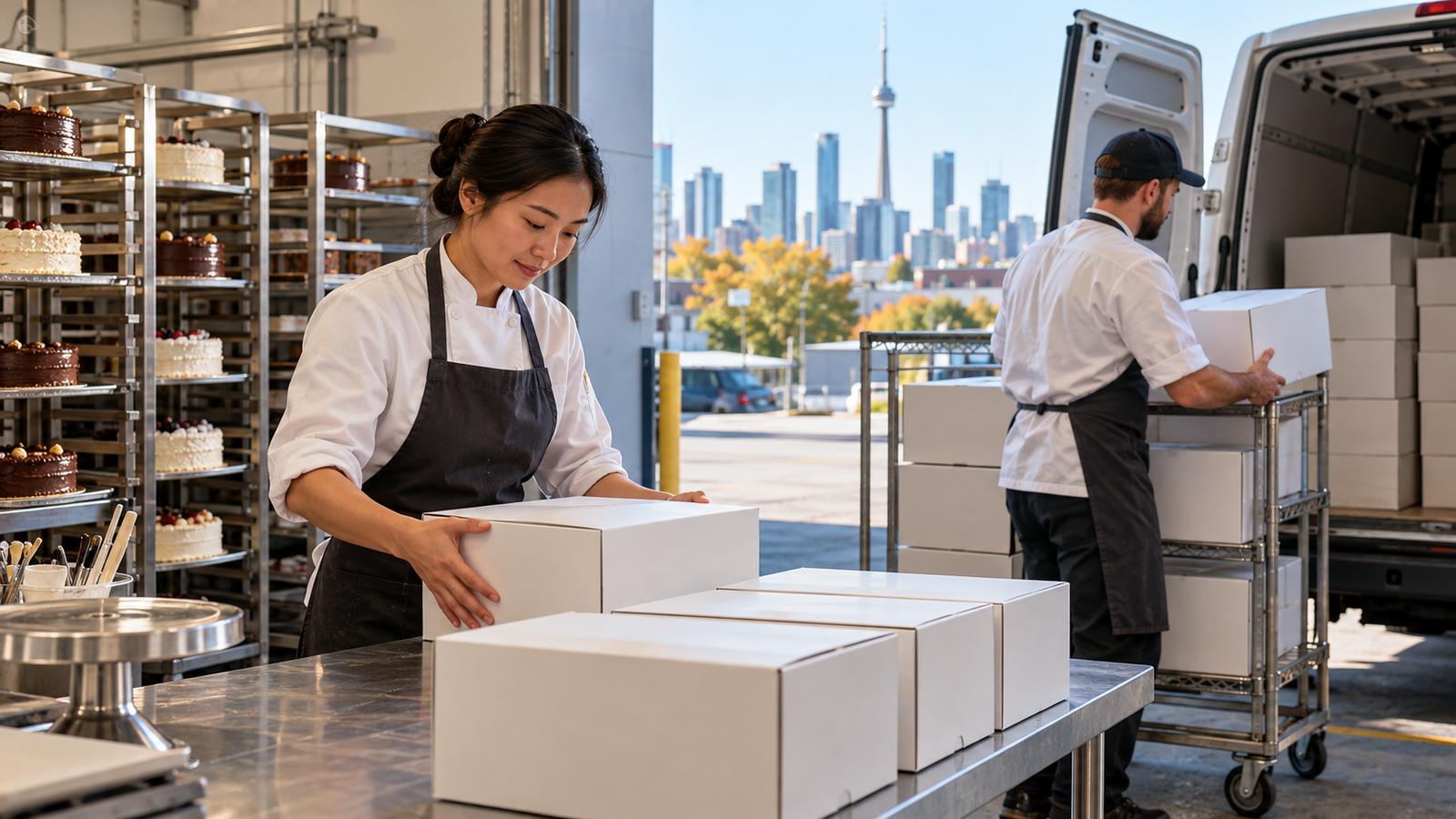
Wholesale Cake Delivery in Toronto and the GTA: From Bakery to Café or Venue
Supply cafés and venues with cakes across Toronto and the GTA. Plan packaging, temperature control, loading, receiver details and proof of delivery.
A bakery in North York makes twelve cheesecakes for a café group. The order is not a surprise. The cafés need the cakes before their lunch service, but one location receives at the back lane, another wants them at a mall loading dock, and a third has no refrigerator space until 10 a.m. This is not the same job as taking one birthday cake to a front door. The cakes are a wholesale product moving between businesses, with stock counts, food handling and receiving responsibilities at every stop.
Wholesale cake delivery in Toronto and the GTA works best when the bakery and the receiving business share one clear plan. This article focuses on café, restaurant, caterer and event-venue accounts. For individual celebration cakes and pastries, see our bakery delivery guide. For a broader catering handoff, our event-day checklist covers a different set of questions.
Start with the production finish, not the departure time
A kitchen may say “the cakes are ready at eight” when the final glaze is setting at eight. Ask when every box will be closed, labelled, counted and safe to load. The pickup time should follow that point, not interrupt it. A vehicle waiting while staff finish packaging adds cost and puts pressure on the team to rush the last boxes.
Put the wholesale purchase order or account reference on the outer transport grouping. Include the destination, item count and any handling note that a driver must know. Keep detailed ingredient and allergen information in the bakery's proper labelling and customer records; a courier should not be expected to interpret those records or answer menu questions at a café counter.
Decide whether each café receives a sealed carton, several individual cake boxes or a reusable tote. The delivery record should use the same count as the pickup record. If the kitchen hands over four totes and the destination says it expected five cakes, those are different units. Reconcile both the transport-unit count and the commercial order inside the bakery's own process.
Match packaging to the cake and the route
A cake can arrive on time and still be unusable. Tall decorations can hit a lid; a soft filling can shift; a heavy cake can crush the box below it. Choose a rigid base and a box with enough clearance for the finished height. Close the box so it cannot spring open in a turn. Place cartons on a stable, clean, level surface with slip resistance and no unrelated heavy goods stacked above them.
Do not assume a driver's vehicle has a purpose-built cake rack. Tell dispatch the dimensions and number of boxes before booking. A dozen modest cheesecakes may fit differently from two tall tiered cakes. If a cake needs to remain upright at all times or cannot be stacked, say so explicitly. A “fragile” label is useful only when the loading plan actually respects it.
For several café stops, arrange boxes in reverse drop-off order if that keeps the first stop accessible without shifting every carton. Attach the destination to the outside of each grouped order. The driver should not need to open food packaging to identify a café's cake. For a venue order that needs a cart or a long walk from the loading bay, agree in advance who supplies the cart and who moves the cake past the receiving point.
Food-safe transport is a requirement to verify
Different cakes have different storage requirements. Shelf-stable baked goods are not the same as cream, custard or other potentially hazardous products. Ontario's Food Premises regulation requires potentially hazardous food to be distributed and transported under specified internal-temperature conditions, generally 4°C or lower or 60°C or higher, subject to stated exceptions. The bakery must determine how its particular product is classified and how it will meet the applicable rule.
Do not confuse a cool day outside with controlled transport. Ask what equipment the courier actually has, how temperature will be maintained, how long loading and travel may take and what record the food business needs. Do not assume a standard vehicle is refrigerated. If the required equipment is not available, change the route or choose a provider that can meet the food-safety plan. A sealed cake box protects the product from handling; it does not prove safe internal temperature.
Agree on responsibility at the destination. A café that cannot put a temperature-sensitive cake into suitable storage on arrival may make an otherwise timely delivery unsafe. Confirm its receiving time, available storage and who signs off. The bakery's food-safety procedure should cover the entire transfer, not end when the vehicle reaches the street.
Map the business entrance, not just the storefront
Toronto and GTA cafés often have different delivery rules from their customer entrances. A mall tenant may use a service corridor. A downtown location may have a rear lane with a narrow receiving period. A venue may demand vendor registration or a loading appointment. Ask the buyer for the actual delivery entrance, unit, floor, loading instructions, named receiver and phone number. Confirm whether the driver is expected to bring goods to a counter, a loading dock or a kitchen door.
If a location says “deliver before opening,” make sure somebody will be there before opening. A locked café with no receiver does not become a successful early delivery because the vehicle arrived on time. For event venues, ask whether the food order and the vendor access booking are held by different staff. A contact who approved the cake purchase may not control the dock.
When the route crosses Toronto, Mississauga and Vaughan, group stops around the receivers' actual windows, not just shortest driving distance. A café that begins service at 11 may need its cake at 9:30; another may have no staff to receive it until 10. A planned route can serve both if the stop sequence is agreed. It cannot solve conflicting windows that nobody reported.
Set an exception process for damaged or missing items
At pickup, note the number of sealed boxes and any visible damage. At delivery, the receiver should compare the transport count and visible condition before accepting. If a box is dented, record the condition and notify the bakery promptly. Do not ask a courier to remove cake packaging or decide whether a decoration is food-safe. The bakery and the buyer should handle product-quality and replacement decisions.
If the receiving person is absent, define who may accept the order and whether the cakes can wait safely. A lobby desk may be unsuitable for a temperature-sensitive product even if it accepts ordinary parcels. If a venue changes the room or arrival time, have the authorized buyer confirm the change with dispatch. A driver cannot assume a revised location is reachable within the original route or safe handling plan.
Use one order reference across the bakery invoice, delivery booking and proof of handoff. This is especially useful for repeat accounts. When a café says a Monday cake was missing, the bakery can compare what it packed with what the courier collected and what the café received. For regular replenishment, consider a scheduled recurring route, but still verify each day's quantities and receiving availability.
A wholesale cake route checklist
- Confirm each product's handling and temperature requirements.
- Set pickup only after all cakes are boxed, labelled and counted.
- Give dispatch the dimensions, box count and no-stacking instructions.
- Get each café or venue's receiving window, entrance and named contact.
- Confirm suitable vehicle equipment rather than assuming it exists.
- Record condition and count at pickup and handoff.
- Set a safe rule for missed receivers, delays and damaged boxes.
For a one-off wholesale order, give dispatch the complete route and product details before agreeing to a customer deadline. For regular replenishment, a route review can show which stops are stable and which need a separate vehicle or time window. To discuss a specific GTA bakery run, share the addresses and handling requirements.
Frequently asked questions
Can a standard courier van carry cream cakes between GTA cafés?
Do not assume so. The bakery must determine the product's food-safety requirements and confirm that the selected vehicle, equipment and route can meet them. A standard van is not automatically a refrigerated vehicle.
Should cake boxes be stacked for a multi-stop wholesale route?
Only if the bakery's packaging and product design allow it. Give dispatch the box dimensions and no-stacking instructions. Heavy cartons or unrelated goods should not be placed on top of fragile cakes.
Who checks the cakes at delivery?
The receiver should check transport count and visible box condition at handoff. The bakery and buyer should handle product-quality questions; the courier should not open food packaging to inspect decorations or ingredients.
What details does a mall café or event venue need to provide?
Give the delivery entrance, loading or vendor-access procedure, unit or room, receiving window, named contact and working phone. A public storefront address may not be the permitted goods entrance.
Is a recurring courier route suitable for wholesale cakes?
It can be when destinations and receiving windows repeat and the required food-safe handling is confirmed. Daily quantities, packaging and receiver availability still need checking, and unusual event orders may need a separate run.