
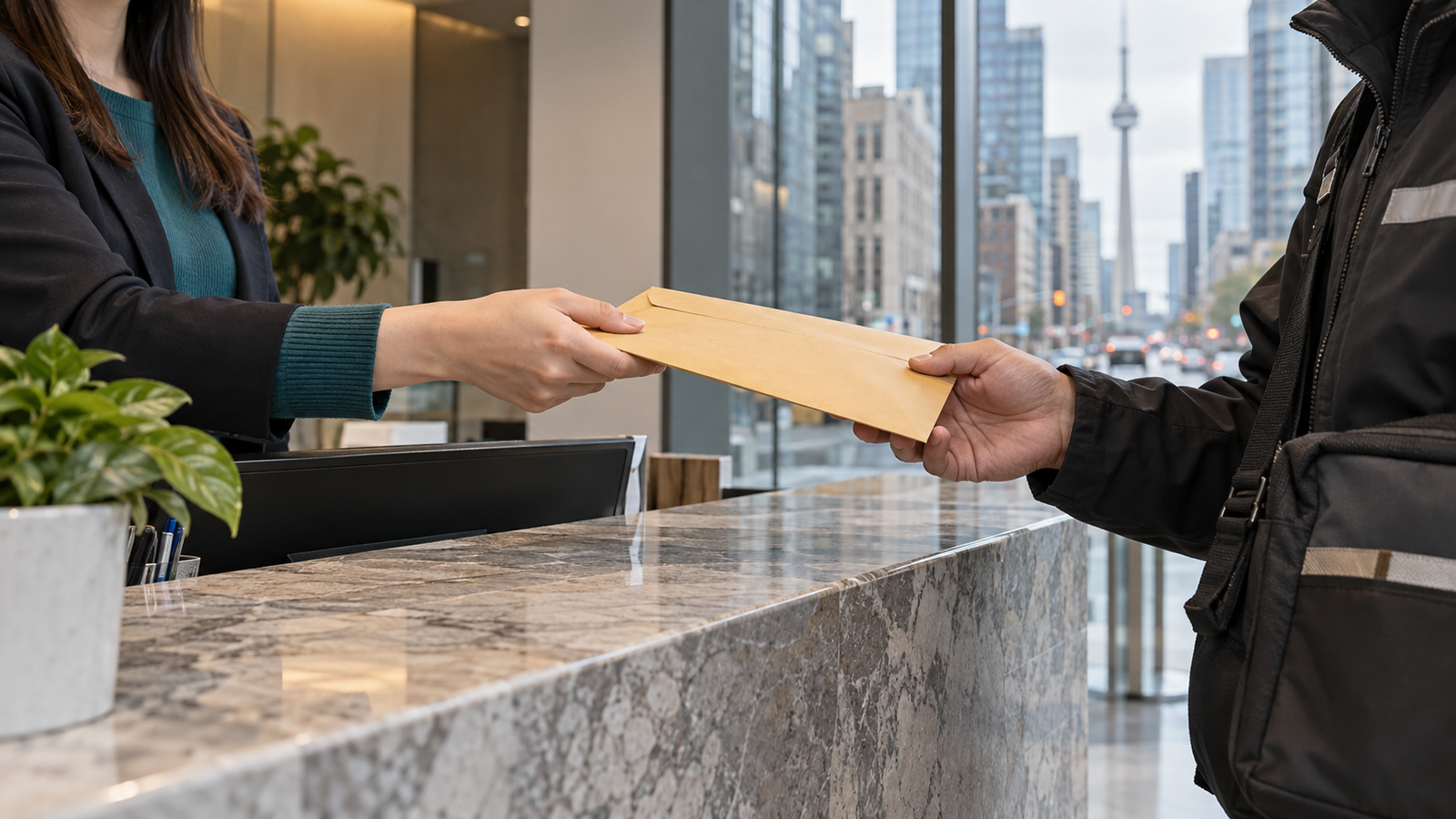
Document Courier in Toronto and the GTA: A Better Handoff for Business Originals
Plan a Toronto document courier run with sealed originals, a named receiver, realistic deadlines and proof of handoff across the GTA.
At 3:15 on a Friday, an office administrator is told that a signed original must reach a client in Mississauga before the office closes. The envelope is ready. The address is in an email. What is missing is the name of the person who will accept it, the actual closing time at that location and a plan if the recipient has already left. Those details can matter more than the kilometres between the two offices.
A document courier in Toronto is useful when a physical original, sample, cheque or signed package really has to move. It is not a substitute for confirming what the receiving organization accepts. This guide is for the person arranging the run, whether they work in a law office, an accounting practice, a property company or a small business. It focuses on the handoff and record, not on choosing a general urgent-delivery speed. For that comparison, see our 1-hour versus 4-hour courier guide.
First ask whether a physical delivery is actually required
Before booking a vehicle, ask the recipient whether they need the original paper, an electronic copy, or both. A wet-ink signature may be important to one transaction but unnecessary for another. The sender, recipient and any professional adviser should make that determination. A courier cannot decide whether a scan satisfies a contract, filing rule or lender requirement.
Court paperwork is an especially poor place to guess. Ontario now offers online routes for many civil and Divisional Court documents, with different rules and timing depending on the document and location. The province's court filing guidance is a starting point, but the person responsible for the matter must confirm the current filing method and deadline. Delivering an envelope to a building is not the same thing as having a court accept and file it. If a physical counter visit is required, confirm the counter's address, hours, fees and acceptance process before dispatch.
For ordinary business documents, the same principle is simpler: ask the receiver what they will acknowledge. Some offices can accept a sealed envelope at reception; others need a particular employee or department. A building may share a mailing address with several tenants. A suite number and a named receiving contact can save a second trip.
Write the deadline in the receiver's language
“ASAP” is not a delivery window. Is the deadline 4:30 p.m. because the office locks its doors, or is 4:30 when someone needs the papers on a desk for review? Does a pickup after 2 p.m. still leave enough time for traffic, elevator access and a signature at the destination? Ask those questions before selecting a same-day or priority option.
Across the GTA, a route from downtown Toronto to Vaughan is different from a short trip between neighbouring offices. Even within one building, security sign-in and elevators add time. Give dispatch a ready-for-pickup time, the latest acceptable handoff time and the consequence if that window is missed. Dispatch can then confirm what is feasible rather than treating a requested deadline as a promise.
If the paperwork must stop at more than one location, put the stops in the correct sequence. A client may need to sign before the package goes to another office. A route that delivers to the final address first does not solve the problem. If a signature, stamp or return copy is required, describe who will arrange it and whether a return leg must be quoted separately. Do not assume a driver can wait indefinitely while documents are reviewed.
Prepare the package as if nobody will explain it en route
Use a sealed envelope or document wallet that will stay closed in a vehicle and through a busy reception area. Put the recipient's organization, full address, suite, contact name and phone on the outside. Keep account numbers, client details and confidential subject lines inside. If there are several folders, label the outer transport units and record the count without listing private contents on a public-facing label.
Make a simple handover record before pickup: one sealed envelope, two document tubes, or whatever is physically leaving the office. The sender should confirm that every page and signature is present. A courier can check package count and visible condition, not the legal or financial completeness of the contents. If an original is irreplaceable, decide internally whether a copy or scan should be retained before it leaves.
Ask the receiving organization about its security procedure. If it will not sign for a package, decide whether a named verbal acknowledgement and timestamp are enough for your business. If the recipient must show identification, communicate that requirement before the driver arrives and confirm it is part of the agreed service. Avoid asking a courier to photograph sensitive pages as proof. A photo of the sealed package at the permitted handoff point may be useful, but the sender should set an appropriate privacy standard.
Give dispatch a real fallback, not a vague instruction
Office receptions close for lunch, meeting rooms move, and a contact can be on another call when the driver arrives. Put a backup phone number on the booking. State whether the driver may leave the package with reception, another named employee or nobody else. “Use your judgement” is risky for confidential material. A clear no-answer rule lets dispatch ask for direction before a package ends up in the wrong hands.
For a Toronto financial district delivery, specify the tower, floor and desk. For a Brampton warehouse, identify the correct gate or receiving office. For a residential business address, confirm whether someone will actually be present. These are not decorative fields. They determine whether the driver can complete the job without making an unplanned stop or exposing the package.
If the destination changes after pickup, send the revised address and authorized receiver through dispatch, not just by texting a phone number that may belong to a driver on another route. Ask dispatch to confirm the new route and any charge. A written change record is particularly useful when several employees are coordinating the same envelope.
Choose the delivery record before the trip
Different documents call for different proof. A routine office envelope may need a timestamp and recipient name. A high-value original may need the sender to reconcile the handoff against an internal register. Decide what your team will record, who may see the record and how long you retain it. Keep the proof proportionate to the material. A public photo of a signature or a detailed document label can create a privacy problem rather than solve one.
After delivery, close the loop with the person who requested the run. Confirm the destination, handoff time, receiver and any exception. If a recipient says the envelope was not what they expected, the sender should review its own contents record and speak directly with the recipient. The transport record can show that a sealed unit changed hands; it cannot prove the contents were correct.
For repeat transfers between the same offices, write a short standing instruction and revisit it whenever staff, access rules or closing times change. A scheduled courier route may fit regular document runs. A true one-off deadline is better treated as its own confirmed booking, with its own contact and timing.
A practical document-run checklist
- Confirm a physical original is required and who is responsible for that decision.
- Get the exact receiving address, suite, name, phone and office hours.
- State when the sealed package is ready and the latest useful handoff time.
- Count transport units and retain a sender-side contents record.
- Set the permitted handoff and no-answer rules.
- Agree on the proof you need without exposing sensitive contents.
- Confirm any return leg, waiting time or second destination separately.
This takes a few minutes at the desk. It can save much longer when an office closes with the envelope still on the road. If the route includes several stops, our multi-stop delivery guide explains how to sequence them. To ask dispatch about a specific GTA document run, send the pickup, destination and real deadline.
Frequently asked questions
Can a Toronto courier deliver original signed documents?
A courier can transport a properly packaged original to an agreed recipient. The sender must confirm that physical delivery is required, that the document is complete and that the receiving organization will accept it at the stated location and time.
Is a delivery photo enough proof for confidential paperwork?
Not always. Decide in advance whether your organization needs a recipient name, timestamp, signature or another internal record. Avoid photographing document contents or personal information just to prove that an envelope arrived.
Can a courier file court documents for me?
Do not assume so. Filing requirements depend on the court, document and current process, and many Ontario documents can be submitted online. The person responsible for the filing should verify the method, fees and deadline before arranging any physical trip.
What happens if the named receiver is away?
Tell dispatch the approved backup receiver and whether reception may accept the sealed package. If nobody authorized is available, the driver should follow the agreed contact and no-answer procedure rather than leave a sensitive envelope unattended.
Should I choose a rush courier or a scheduled document run?
Use a confirmed one-off service for an exceptional deadline. A scheduled route can make sense when the same offices exchange documents regularly, but it still needs current receiving names, access times and a clear exception plan.